App Guides
Disposable Camera Apps for Couples: One Shared Roll, Revealed After Goodbye
Inside CloserTo
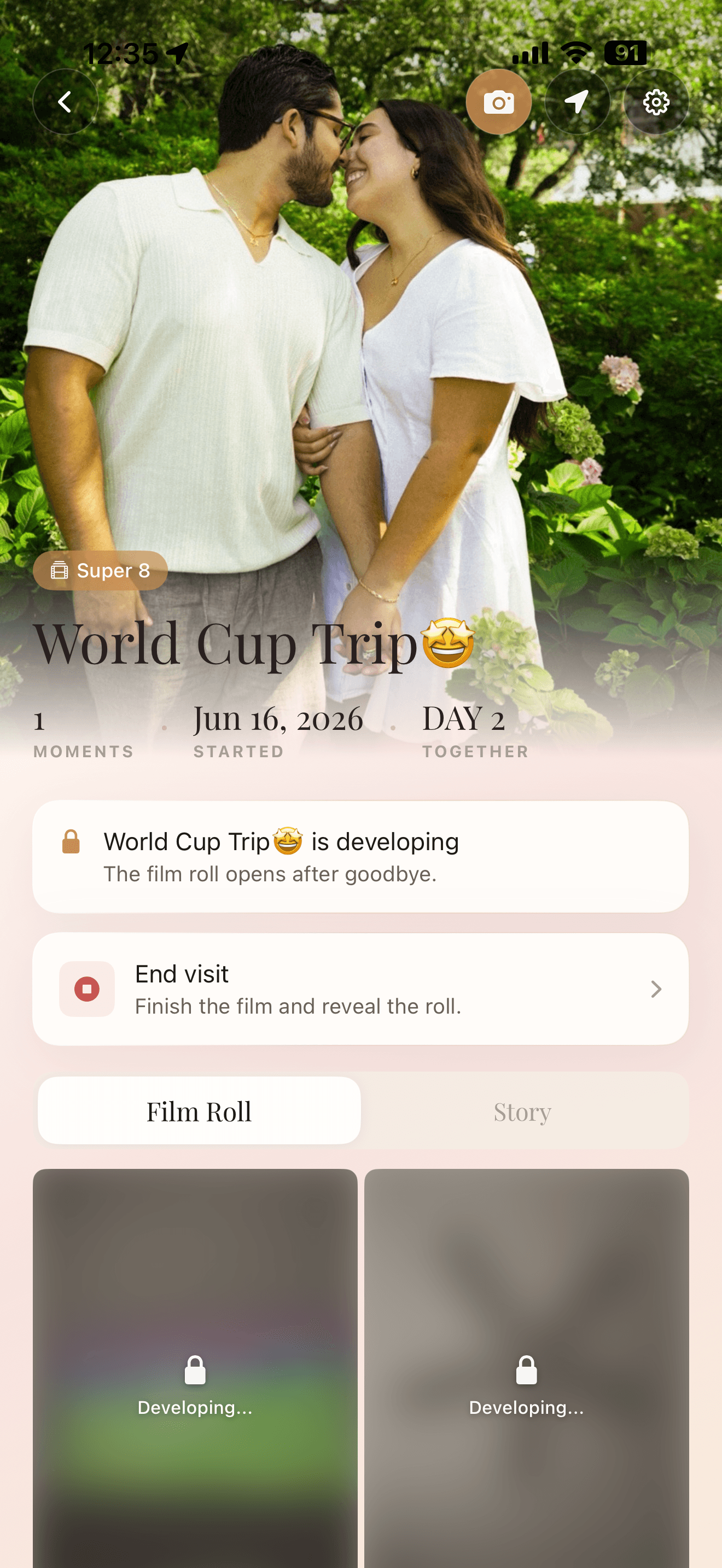
Visit Film works like a shared disposable camera: capture together, then open the roll after goodbye.
There’s a reason every wedding suddenly has a QR code on the table inviting guests to shoot into one shared camera roll, and a reason half your feed looks like it was shot on expired film. After a decade of taking forty near-identical photos and agonizing over the best one, people are craving the opposite: one shot, no preview, and a reveal you have to wait for.
Disposable camera apps bottle that feeling without the drugstore developing fees. And while weddings made the format famous, there’s a group it fits even better: long-distance couples, whose time together is rare, short, and far too precious to spend staring at a screen. Here’s why the format works, and how to use it on your next visit.
What is a disposable camera app, and why is everyone suddenly using one?
The idea is simple: the app behaves like a single-use film camera. You point, you shoot, and then... nothing. No preview, no retake, no edit screen. The photo goes into a roll that stays hidden until it “develops” later, usually with a film-style look baked in — grain, warm tones, the occasional light leak. Weddings and parties ran with it first: one shared roll, every guest shoots into it, and the couple wakes up the next morning to hundreds of candid photos nobody posed for.
Why it’s having a moment is the more interesting question. Somewhere along the way, taking photos became a small performance — frame it, review it, retake it, pick a filter, maybe post it. Disposable camera apps quietly delete every one of those steps. You can’t review, so you stop performing. You can’t retake, so the blurry mid-laugh photo survives. And because the reveal comes later, photography gets back the one thing phones took from it: surprise.
Why the format fits long-distance couples even better than weddings
A wedding is one big night. Your visits are something rarer: they’re the entire in-person life of your relationship, compressed into a handful of weekends a year. When you only get 48 hours together, the math is brutal — every minute spent curating a camera roll is a minute you weren’t actually with them.
- Your time together is scarce. A couple who shares a city can retake the photo next weekend. You can’t. The one-shot format matches the one-chance reality.
- Being present matters more than getting the shot. With no preview to check, you take the photo and put the phone away. That’s the whole interaction.
- Candid beats curated when you’re starved for the real them. What you’ll ache for later isn’t the posed photo — it’s them squinting at a menu, laughing at nothing, existing next to you.
The reveal lands exactly when the post-visit blues hit
And then there’s the timing of the reveal, which is where the format goes from cute to genuinely kind. Everyone in a long-distance relationship knows the post-visit crash: the flight home, the apartment that suddenly feels too quiet, the first brutal days after saying goodbye. A wedding roll develops into a fun morning-after surprise. A visit roll develops into something closer to first aid — a stack of unseen photos of the two of you, arriving exactly when you miss each other most.
How a visit film works in CloserTo, step by step
CloserTo calls its version a visit film — a disposable-camera roll for the two of you, wrapped around a single trip. Here’s the whole flow:
- Create a visit. When a reunion is coming up, start a new visit film in the app.
- Name it. “Spring Reunion.” “Tokyo, Finally.” “The Weekend We Didn’t Leave the Apartment.” The name becomes the title on the roll forever, so have fun with it.
- Pick a lens. Choose the look for the whole roll — Natural, Film, or Noir. One aesthetic per visit, locked in up front.
- Invite your partner. Both of your phones shoot into the same shared roll. Two photographers, one film.
- Capture as you go. During the visit, every photo you take stays “developing” — hidden, even from you. There’s no gallery to scroll while you’re together, which is exactly the point.
- Say goodbye. The worst part of every visit, made slightly less awful by what comes next.
- Open the roll, one photo at a time. After the visit ends, the developed film reveals photo by photo. You see everything you shot — and everything they shot that you never noticed.
Make the reveal a ritual
That last step deserves its own little ritual. Some couples open the roll together on a video call the night after goodbye, narrating each photo as it appears. Others save it for the worst moment — the flight home, the first lonely Sunday — and let it land like a letter from three days ago. There’s no wrong way, but deciding together beforehand turns the reveal into a shared event instead of two separate scrolls.
The three lenses (and why you can’t change your mind later)
- Natural — warm golden tones. The closest to real life, just on its best day.
- Film — dreamy analog grain with light leaks. The default, and the one that most feels like a shoebox of prints from 1998.
- Noir — dramatic black and white. For the cinematic visits, or the couples who are a little dramatic themselves.
One lens per roll, chosen before you shoot a single frame. No filters after the fact, no retakes, no cropping your way to perfection later. If that sounds restrictive — it is, deliberately. The constraint is what makes a roll feel like a roll: thirty photos that hang together like a real pack of prints, instead of thirty separate editing decisions. The slightly blurry photo of them laughing stays in. Years from now, it’ll be your favorite one.
After the reveal: collages and the memory shelf
Once a roll has developed, it doesn’t just sit in a folder. You can turn it into a Collage — Polaroid, Film, Scrap, or Minimal layouts — which is the shareable version of the trip: one image that says “this was us” without dumping forty photos on your group chat.
Every visit film also lands in Memories, CloserTo’s archive, alongside your daily photos and journal entries. Throwbacks resurface old moments when you least expect them, and Stats quietly keeps score of the things worth counting: days together, days apart, visits, moments captured. Over a year or two of distance, the Visits shelf becomes something real — a row of named film rolls that is, literally, the story of every time you closed the gap.
How to shoot a visit roll you’ll actually love: 12 shot ideas
With a limited roll, aim at moments, not monuments. The skyline will be on ten thousand postcards; the way they hold their coffee will not. Steal from this list:
- The airport hello. Hand your phone to a stranger, or just catch them walking toward you through arrivals.
- Their coffee order, in their hands, at the place that becomes “your place” by day two.
- The hotel or bedroom mirror photo. A classic because it works.
- Them mid-laugh at something that will make zero sense later. That’s the point.
- The most ordinary errand you run together. Groceries, the pharmacy, gas station snacks. Domestic life is the thing distance steals — photograph it.
- What breakfast looked like on the slow morning.
- Their side of the bed, while it’s still theirs.
- One photo they take of you when you don’t notice. You’ll find it in the reveal.
- A golden-hour walk photo where nobody was posing.
- The view from the best moment of the trip, whatever that turns out to be.
- The last morning. Soft light, packed bags, all of it.
- The moment right before goodbye. It will hurt to take and be your favorite to open.
If you’re still planning the trip itself, our long-distance date ideas guide has plenty of reunion material worth pointing a camera at. But honestly, the roll doesn’t need an itinerary. It needs the two of you in the same place, a little unguarded, taking one shot and moving on.
That’s the quiet genius of the disposable camera format for couples like you: it takes the pressure of documenting off your shoulders during the hours that matter, and hands the memories back when the missing starts. You were present for the visit. The photos were patient. Both things get to be true.
Frequently asked questions
- What is a disposable camera app?
- A disposable camera app recreates the experience of shooting on a single-use film camera: you take a photo, you can’t preview or retake it, and it stays hidden until the roll “develops” later. Most add a film-style look, like grain and light leaks. The appeal is the surprise — you stay present while shooting and get the reveal as a gift afterward.
- How is CloserTo different from wedding disposable camera apps?
- Wedding apps are built for one event and a crowd of guests; CloserTo is built for exactly two people who don’t live in the same place. A visit film is a shared roll you both shoot into during a trip together, and it develops after you say goodbye — timed for the post-visit blues, not the morning after a party. It also lives inside a bigger long-distance toolkit: daily photo exchanges, a shared journal, countdowns, and a Memories archive.
- Can I see the photos during the visit?
- No — and that’s the point. While the visit is active, every photo stays “developing” and hidden, so there’s no scrolling the gallery mid-trip and no deleting the unflattering ones. The full roll reveals one photo at a time after the visit ends, when you’re back to missing each other.
- How many photos can we take per visit?
- On CloserTo’s free tier, each visit film holds 3 photos — enough to try the format on your next trip. CloserTo+ unlocks unlimited film photos plus all three lenses, and only one partner needs to subscribe for both of you to get everything.
Keep reading
App Guides
Open When Letters: 25+ Ideas for Long-Distance Couples
Open when letters let you comfort your partner at the exact moment they need it, even when you’re asleep three time zones away. Here’s what to write and when.
App Guides
The Long-Distance Countdown: Why Counting Down to Your Next Visit Works
A countdown gives every goodbye an expiry date. Here’s the psychology behind why it helps, and how to put your reunion countdown right on your lock screen.
App Guides
The Distance Between Us Widget: Put the Miles on Your Lock Screen
The TikTok-famous distance widget, explained: why seeing the miles between you matters, what you need on iPhone, and how to set it up in a couple of minutes.