
Long-Distance Tips
How to Make a Long-Distance Relationship Work: A Real Playbook
Inside CloserTo
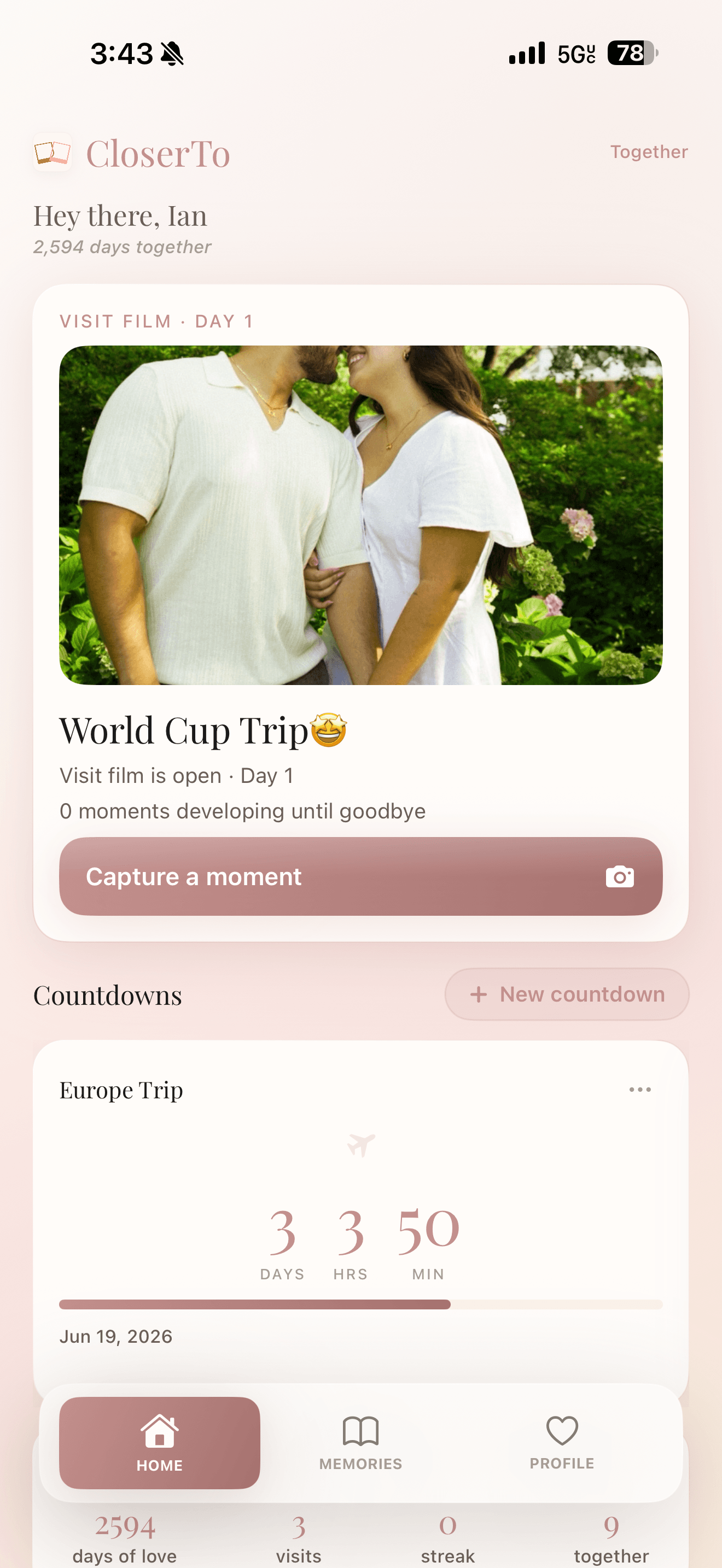
CloserTo is built around the real rhythm of long distance: waiting, visiting, remembering, and waiting again.
Here’s the thing nobody tells you when you fall for someone who lives far away: making it work has very little to do with how much you love each other, and almost everything to do with the systems you build together. Love is the easy part. The habits, the expectations, the plan — that’s the work, and the good news is that it’s learnable.
So let’s skip the generic “stay positive” advice. This is a concrete playbook: the specific habits and structures that turn a long-distance relationship from something you white-knuckle through into something that genuinely feels close. If you’re still in survival mode, start with how to survive a long-distance relationship — then come back here to build something that lasts.
1. Define the relationship — out loud, on purpose
Distance has a way of making things ambiguous, and ambiguity is where anxiety grows. Before anything else, get explicit about what you are to each other. Are you exclusive? Are you boyfriend and girlfriend, partners, dating? It feels almost too direct to say out loud, but assuming you’re on the same page is where so many long-distance couples quietly drift.
The conversations worth having early
- Exclusivity: Are you both off the apps? Say it plainly.
- Labels: What do you call each other to friends and family?
- Boundaries: What feels okay around nights out, friendships, and social media — and what doesn’t?
- The endgame: Do you both eventually want to live in the same city? This one is non-negotiable to align on.
If these feel hard to bring up, that’s normal — and it’s a muscle you’ll use constantly. A good set of questions to ask in a long-distance relationship can make the first conversation feel less like an interrogation and more like getting to know each other on purpose.
2. Set communication expectations (quality over quantity)
The biggest myth in long distance is that more communication is always better. It isn’t. Couples who text every waking minute often burn out, run out of things to say, and turn small misunderstandings into all-day spirals. What actually keeps you close is a rhythm you can both sustain — and that you’ve actually agreed on, rather than silently expecting.
Build a rhythm, not a quota
Try a simple structure: a short good-morning and good-night check-in to bookend the day, plus a few longer calls each week where you’re fully present — no scrolling, no half-watching TV. Then protect those calls. A 20-minute conversation where you’re both actually there beats three hours of distracted “u up?” texting every time.
The goal isn’t to be in constant contact. It’s to make the contact you do have feel like you’re in the same room.
— On building a sustainable LDR rhythm
Variety helps too. Voice notes for when you’re busy, a video call for the big stuff, a shared playlist, a photo of your lunch just because. If your calls have started to feel like status updates, switching up the medium — and trying a few long-distance relationship activities you can do together — pulls you out of the rut fast.
3. Have a clear timeline to close the distance
If there’s one thing that separates the long-distance relationships that make it from the ones that quietly fade, it’s this: a shared answer to the question “when does this end?” Not the relationship — the distance. Open-ended distance with no plan is exhausting, because every hard day feels like it could be forever.
You don’t need every detail mapped out. You need a direction and a rough horizon: “We close the gap within two years,” “One of us moves after graduation,” “We reassess every six months.” A timeline turns the distance from a permanent state into a temporary chapter — and that reframe changes everything about how the hard moments feel.
4. Plan and budget visits like they matter (because they do)
Visits are the heartbeat of a long-distance relationship. They’re also the part people leave most to chance — and then resent when months go by without one. The fix is to treat seeing each other as a planned, budgeted priority, not a someday-when-we-can-afford-it luxury.
A simple visit system
- Always leave with the next date booked. Never say goodbye without the next visit on the calendar. It’s the single best antidote to a painful goodbye.
- Open a shared visit fund. Even a small automatic transfer each week into a “flights” pot makes trips feel inevitable instead of impossible.
- Alternate who travels. Splitting the effort (and the cost) keeps resentment from building on either side.
- Set flight-deal alerts. Flexibility on dates can cut costs dramatically — book the cheap window, then plan around it.
And remember that the goodbyes are the hardest part for almost everyone — that’s not a sign anything’s wrong. If the post-visit comedown hits you hard, coping after saying goodbye in long distance has gentle, practical ways through it.
5. Build trust through everyday transparency
Trust in long distance isn’t something you declare once and forget. It’s built in a thousand tiny, boring moments of being where you said you’d be and saying what’s actually going on. When your partner can’t see your day, predictability is intimacy.
- Share your plans casually — who you’re out with, when you’ll be home — not because you owe a report, but because it closes the gap distance creates.
- Don’t go silent when you’re upset. The instinct to withdraw reads very differently when someone can’t walk over and check on you.
- If something feels off, name it early. Small worries left to marinate over distance become big stories.
- Keep your word on the little things — calling when you said you would builds more trust than any grand gesture.
Jealousy and insecurity are normal; the question is whether you process them together or let them fester. Couples who do this well tend to be remarkably reassured by the numbers, too — the long-distance relationship statistics consistently show that LDRs are far more durable than the stereotype suggests.
6. Keep your own life full
This one feels counterintuitive, but it’s essential: the strongest long-distance relationships are made of two people with full, independent lives — not two people pressing pause until they’re reunited. When your whole sense of happiness rests on your partner being available, every missed call feels like a crisis.
Pour into your friendships, your hobbies, your goals, your routines. Not as a distraction from missing them, but because a full life makes you a happier partner and gives you something to actually talk about. The most magnetic thing you can bring to a call is a life you’re genuinely excited about. Protecting your own world isn’t a threat to the relationship — it’s what keeps you from quietly resenting it.
7. Learn to fight well over text and call
You will disagree. The trick is that distance strips out tone, body language, and the comfort of a hug afterward — so conflict needs different rules than it does in person.
- Don’t fight over text. Move anything serious to a call or video. Typed words harden in a way spoken ones don’t.
- Name the feeling, not just the fact. “I felt forgotten when you didn’t call” lands better than “you never call.”
- Take timeouts, but say so. “I need an hour to think, I’m not leaving” prevents a pause from feeling like abandonment.
- Don’t let a visit be ruined by a grudge. Repair before the next trip; precious in-person time is too rare to spend cold.
Repairing well over distance is a skill, and it gets easier with practice. If conflict is your sticking point, the survival-focused guidance in how to survive a long-distance relationship goes deeper on de-escalating when you can’t just hug it out.
8. Create shared rituals and celebrate milestones
Closeness doesn’t only happen on big calls or visits — it’s built in small, repeated moments that are yours. Rituals are how you create a shared world when you don’t share a zip code, and they’re the quiet glue of a long-distance relationship that works.
Rituals that actually stick
- A standing weekly date night — same time, same vibe — that you both protect like a real appointment.
- A daily photo swap so you each get a glimpse of the other’s ordinary life.
- Watching a show “together,” pressing play at the same second across time zones.
- Marking the small wins — a month down on the countdown, a tough exam survived, a flight finally booked.
Hunting for fresh ideas to keep it from going stale? A running list of long-distance relationship date ideas is worth keeping close. And the right tools make rituals effortless — see the best long-distance relationship apps for what to put in your toolkit. CloserTo was built for exactly this: its Visit Film captures a disposable-camera roll while you’re together that develops and reveals only after you say goodbye, turning every trip into a little gift you open later. You can explore how the together and apart modes keep both halves of the distance feeling connected.
The real secret
Making a long-distance relationship work isn’t about gritting your teeth until you’re finally in the same place. It’s about building a relationship that already feels close — through clear expectations, a real plan, steady trust, full lives, and rituals that show up every single day. Do that, and the distance stops being the thing that defines you. It becomes just the chapter before the rest of your story.
Pick one system from this list and start it this week. You don’t have to fix everything at once — you just have to begin.
Frequently asked questions
- Can a long-distance relationship actually work long term?
- Yes — but it works because of systems, not luck. Couples who go the distance tend to have an agreed timeline to eventually live in the same place, regular visits, and shared daily rituals. The relationships that struggle are usually the ones with no end date and no structure, not the ones that are simply far apart.
- How often should you talk in a long-distance relationship?
- There’s no magic number. What matters is consistency and quality over raw volume. Many couples do one short daily check-in plus one longer call a few times a week, then adjust to fit both of your schedules. The goal is connection you can sustain, not a quota that leaves you both exhausted.
- What is the hardest part of a long-distance relationship?
- For most people it’s the goodbyes after a visit and the stretch of uncertainty when there’s no clear plan to close the gap. Both get easier with a concrete countdown to the next visit and an agreed long-term timeline, so the distance feels temporary instead of open-ended.
Keep reading
Long-Distance Tips
Long-Distance Relationship Gifts That Actually Feel Personal
The best long-distance gifts are not expensive for the sake of it. They give your partner something to hold, open, watch, revisit, or look forward to.
Long-Distance Tips
How to Build a Long-Distance Communication Schedule That Works
A communication schedule should reduce anxiety, not turn your relationship into a meeting calendar. Here is how to build one that still feels human.
Long-Distance Tips
Long-Distance Care Package Ideas for the Weeks They Need You
A good care package is not a box of random cute things. It is a small, physical way to say: I know the week you are having, and I am with you in it.